Schilling Editorial Desk

Schilling Editorial Desk
In most publishing organisations, the biggest risk isn’t at the end of the pipeline – it’s at the beginning.
Manuscripts arrive through multiple channels. Priorities are unclear. Evaluation varies from editor to editor. And decisions are made without a shared, structured foundation.
- For editors, this creates friction and inconsistency.
- For editorial managers, it limits visibility and control.
- For leadership, it leads to misallocated resources and missed opportunities.
What starts as intake uncertainty becomes weaker decisions, slower progression and reduced portfolio quality across the entire pipeline – from submission to publication.
What it takes to fix it
Improving outcomes downstream requires control upstream.
Editorial intake needs to become:
- Structured and comparable across all submissions.
- Transparent across roles and responsibilities.
- Aligned with workflow, ownership, and next steps.
- Designed to support real editorial decision-making – not just documentation.
Without this foundation, even strong teams struggle to scale quality and consistency.
Schilling Editorial Desk – a unified platform for better decisions and control
Bring clarity, consistency, and momentum to your publishing pipeline from the very beginning
Schilling Editorial Desk is a unified, role-based workspace for editorial teams, bringing together manuscripts, review, assessment, workflows, metadata, and AI-assisted support – in one connected environment.
- For editors, it creates a clear place to read, assess, and act.
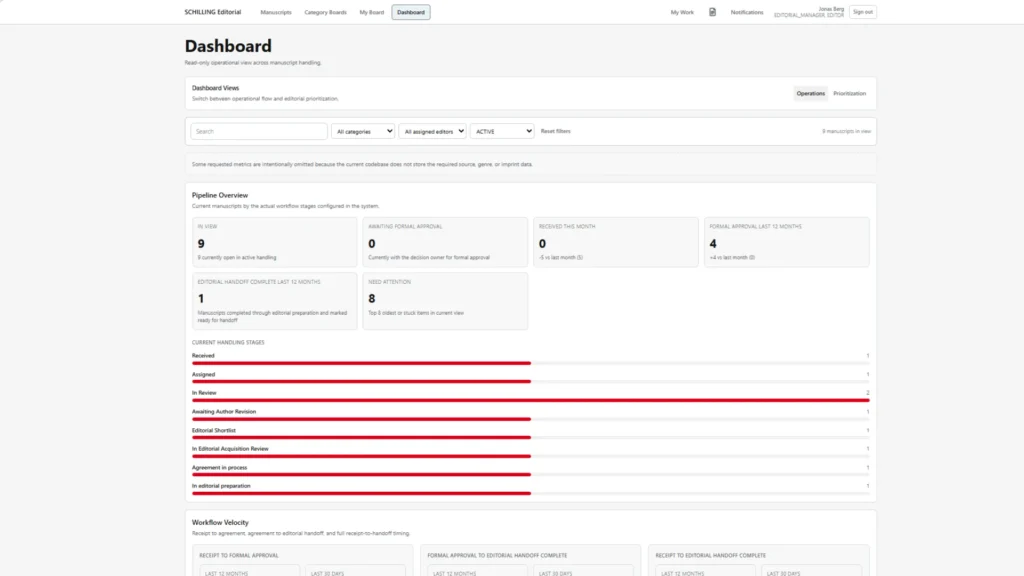
- For managers, it provides visibility across submissions, workload, and pipeline flow.
- For leadership, it enables a more predictable and controllable editorial operation.
Turn intake into a true editorial gatekeeping phase
Move from passive intake to active portfolio shaping
- Prioritise incoming manuscripts based on structured editorial signals.
- Assess publication potential early with consistent evaluation criteria.
- Assign responsibility clearly among editors, reviewers, and teams.
- Establish a controlled gatekeeping stage before further investment.
This is where editorial direction is set – not just recorded.
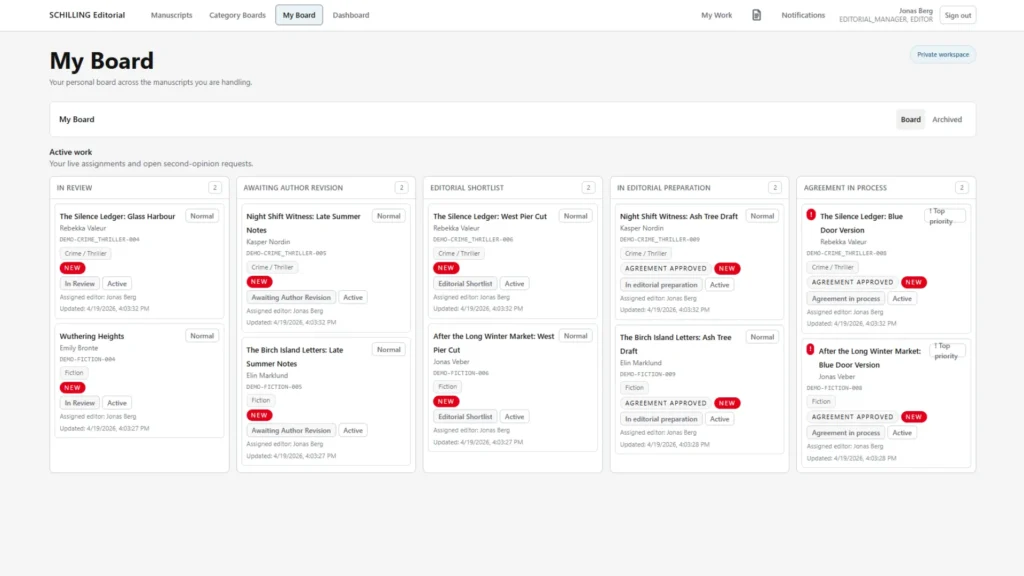
Gain full visibility across workflow, ownership and progress
Editorial work becomes significantly more effective when it is visible and aligned
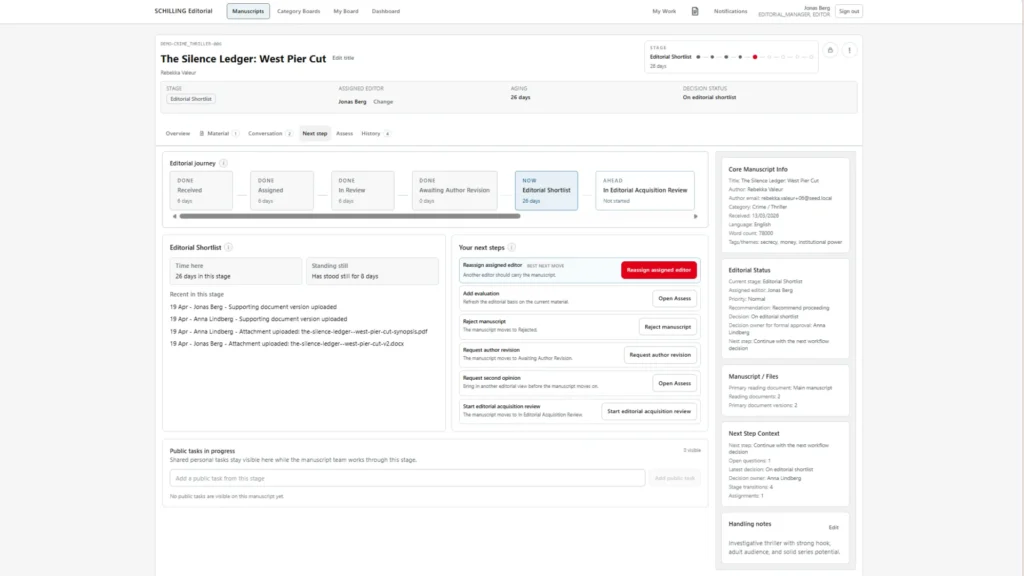
- Manuscript status and next steps are always clear.
- Responsibilities follow ownership and workflow progression.
- Shared tasks and follow-ups are visible across the organisation.
- Decisions and changes are fully traceable over time.
This creates stronger coordination across editors, managers and functions — without adding administrative overhead.
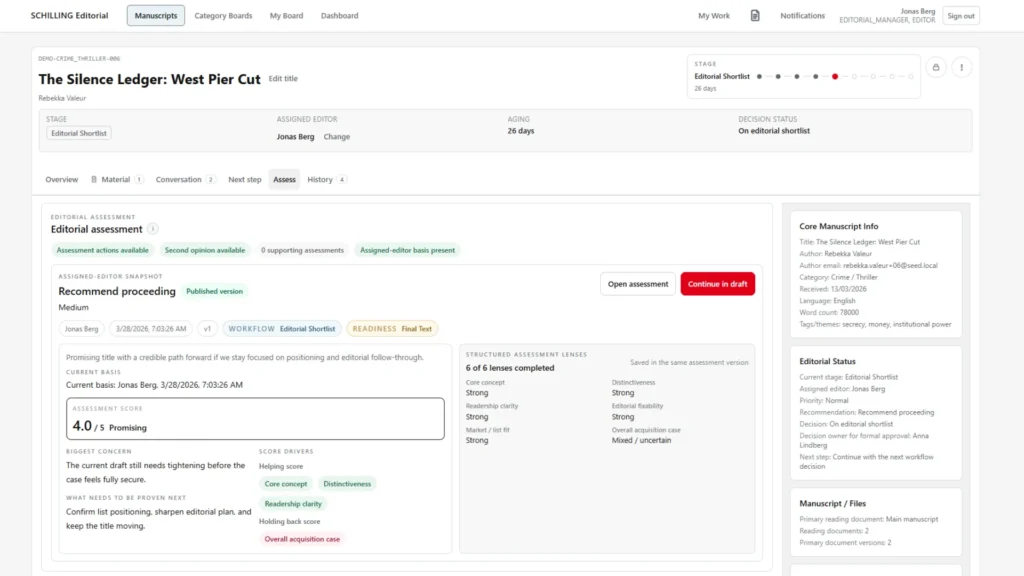
Improve decision quality with structured evaluation
Replace fragmented notes and subjective judgments with a shared evaluation model
Evaluate manuscripts across key editorial dimensions such as concept strength, distinctiveness, audience clarity and acquisition potential – enabling consistent, comparable decisions across teams.
AI-assisted support helps summarise material and structure thinking, while keeping editorial responsibility firmly with the user.
The result is not automated decision-making – but better-informed editorial judgment.
The impact: better decisions, stronger pipeline performance
By structuring intake and early-stage workflows, you create measurable impact across the organisation:
- Editors focus on the right manuscripts.
- Managers gain control of pipeline flow and workload.
- Leadership improves portfolio quality and resource allocation.
- Fewer weak titles move forward.
- More promising titles are identified earlier.
- And decisions become faster, clearer and more consistent.
Schilling Editorial Desk
Explore the categories and all features
All
Editorial intake and decision-making
Workflow, ownership, and execution
Editorial workspace
Metadata, AI, and pipeline intelligence
Controlled manuscript visibility
Role- and category-based access to relevant submissions
Centralised intake overview
All incoming manuscripts in one structured view
Smart submission prioritisation
Focus on the most relevant manuscripts based on editorial criteria
Structured editorial assessment
Comparable scoring models for consistent evaluation
Early publication evaluation
Assess potential before committing resources
Confidence and effort indicators
Understand risk, quality, and required editorial effort
AI-assisted reading and assessment
Generate reading briefs and support structured evaluation
Stage-based workflow control
Manage progression with clearly defined stages and transitions
Role-based decision permissions
Ensure that the right people take the right actions at the right time
Clear ownership and accountability
Assign and track responsibility among editors and teams
Shared tasks and follow-ups
Coordinate next steps with shared tasks, linked to each manuscript
Automated next-step tasks
Trigger follow-ups automatically based on workflow status
Full workflow visibility
Track status, responsibilities, and next steps at all times
Complete history and audit trail
Maintain full traceability of decisions, actions, and changes
All-in-one editorial workspace
Combine reading, assessment, workflow, and metadata in one place
Context-aware user experience
See relevant actions based on role, stage, and access
Structured document and version control
Work from a clear and reliable version of each manuscript
Personal workspace for focus and planning
Keep notes, ideas, and ongoing work separate from shared workflow
'My Desk' dashboard for prioritisation
Manage tasks, responsibilities, and personal workload in one view
Structured metadata management
Capture descriptive and classification data in a consistent model
Standards-based classification support
Work with Thema, BISAC, and industry-aligned metadata standards
AI-assisted metadata enrichment
Generate and refine metadata with intelligent suggestions
Metadata readiness insights
Identify what is complete, missing, or needs review
Pipeline visibility and workflow overview
Understand distribution, progression and bottlenecks across different stages
AI-powered inspection and summarisation
Analyse manuscripts and structure insights more efficiently
Controlled manuscript visibility
Role- and category-based access to relevant submissions
Centralised intake overview
All incoming manuscripts in one structured view
Smart submission prioritisation
Focus on the most relevant manuscripts based on editorial criteria
Structured editorial assessment
Comparable scoring models for consistent evaluation
Early publication evaluation
Assess potential before committing resources
Confidence and effort indicators
Understand risk, quality, and required editorial effort
AI-assisted reading and assessment
Generate reading briefs and support structured evaluation
Stage-based workflow control
Manage progression with clearly defined stages and transitions
Role-based decision permissions
Ensure that the right people take the right actions at the right time
Clear ownership and accountability
Assign and track responsibility among editors and teams
Shared tasks and follow-ups
Coordinate next steps with shared tasks, linked to each manuscript
Automated next-step tasks
Trigger follow-ups automatically based on workflow status
Full workflow visibility
Track status, responsibilities, and next steps at all times
Complete history and audit trail
Maintain full traceability of decisions, actions, and changes
All-in-one editorial workspace
Combine reading, assessment, workflow, and metadata in one place
Context-aware user experience
See relevant actions based on role, stage, and access
Structured document and version control
Work from a clear and reliable version of each manuscript
Personal workspace for focus and planning
Keep notes, ideas, and ongoing work separate from shared workflow
'My Desk' dashboard for prioritisation
Manage tasks, responsibilities, and personal workload in one view
Structured metadata management
Capture descriptive and classification data in a consistent model
Standards-based classification support
Work with Thema, BISAC, and industry-aligned metadata standards
AI-assisted metadata enrichment
Generate and refine metadata with intelligent suggestions
Metadata readiness insights
Identify what is complete, missing, or needs review
Pipeline visibility and workflow overview
Understand distribution, progression and bottlenecks across different stages
AI-powered inspection and summarisation
Analyse manuscripts and structure insights more efficiently
Turn editorial intake into a strategic advantage
Editorial intake is not just an operational step – it is where portfolio quality is shaped.
- Better decisions, earlier in the pipeline.
- Stronger operational control and fewer bottlenecks.
- Less fragmentation and clearer collaboration across teams.
- Higher metadata quality and a more predictable pipeline.
See how Schilling Editorial Desk works in practice
We know you’re busy, but if it seems relevant, we’d be happy to show you a very brief demo.
Fill out the form and we’ll get back to you quickly to schedule your demo.