

BookTok and social media are redefining publishing lifecycle management
Social media and BookTok are reshaping the lifecycle of books, making flexible publishing lifecycle management more important than ever.
4 min read.
[Read article in Danish]
For many years, the publishing industry has followed a relatively predictable model: A title was launched, reached its sales peak, and then gradually moved to the backlist.
That model is now under pressure.
Social media – especially BookTok and Instagram – have fundamentally changed how books are discovered, shared, and rediscovered. Forbes describes how social platforms are driving “a new era in publishing,” where even older titles can suddenly find new commercial momentum through viral exposure.
As a result, the traditional linear lifecycle is giving way to a more unpredictable and circular dynamic.
A title can remain dormant for years – and suddenly see a surge in demand.
From linear lifecycle to dynamic publishing
Publishing used follow a largely linear model. Today, publishers are seeing viral breakthroughs, renewed interest, new formats, and recurring waves of demand.
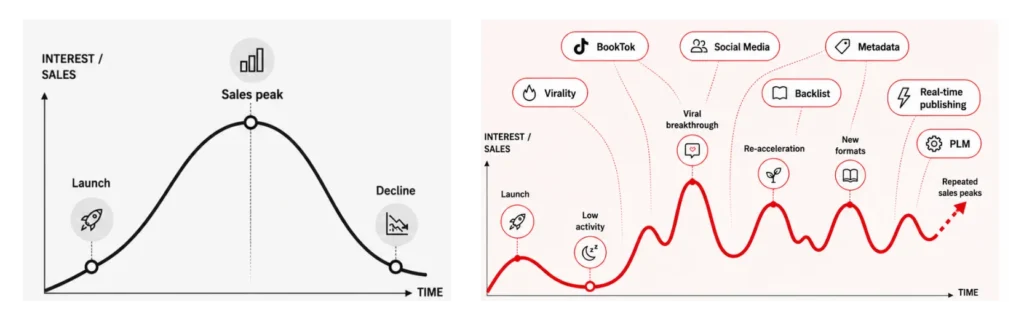
A title’s success is no longer defined by the launch alone. Its success depends on the publisher’s ability to respond when market attention suddenly shifts.
Financial Times describes how social media is fuelling a new long-tail economy, where older backlist titles are revived through digital visibility and online communities.
This also means that the backlist is no longer a passive category, but an active and commercially valuable part of the portfolio in modern publishing lifecycle management.
How BookTok is changing the book market
This shift places far greater demands on publishing lifecycle management and publishers’ internal processes.
When demand can emerge suddenly and without warning, publishers must be able to:
- Reactivate titles quickly, for example through fast reprints.
- Release new editions, such as new formats or covers.
- Adjust metadata and positioning.
- Coordinate work between editorial, marketing, sales, and rights teams.
- Adapt royalty models and create greater contractual flexibility.
Timing has become critical. Momentum created on social media can be short-lived, and the real value lies in the ability to respond fast and in a coordinated way.
Recent research also shows that BookTok is not only influencing marketing, but reshaping how books are produced, distributed, and brought back into circulation.
The study BookTok Helped Us Sell It describes how social media has changed how publishers work with backlist titles, visibility, and emerging genre trends such as romantasy.
Complexity is growing – especially in rights and royalties
When older titles gain new life, additional complexity follows:
- More territories become active again.
- New formats are introduced.
- Sales patterns change significantly.
- Royalty calculations become more dynamic.
- The need for transparency and precision in rights and royalty management grows.
At the same time, social media is influencing the broader ecosystem around books – including streaming, film and TV rights, and international publishing.
Why publishing lifecycle management has become strategically important
In this new environment, publishing lifecycle management is no longer just an operational tool, but a strategic necessity.
A modern publishing lifecycle management solution must be able to:
- Provide full visibility into the lifecycle of titles.
- Support rapid reactivation and republication.
- Manage multiple versions and formats of the same title.
- Ensure consistency of data across the organisation.
- Provide transparency in sales, rights, and royalties.
In short: It must enable publishers to respond quickly and cohesively when the market shifts.
From control to agility
Perhaps the biggest change is not technological, but conceptual.
Publishing is no longer just about planning a launch. It is about navigating a market where demand may return at any time.
That requires systems and workflows that are:
- Flexible.
- Connected.
- Data-driven.
- Transparent.
Social media is changing the dynamics of the backlist
Social media has made the book market more dynamic – and far more unpredictable.
BookTok’s influence has grown to the point where it is now being incorporated into official industry measurements and commercial ranking models in several markets – a clear sign that social platforms are no longer peripheral marketing channels, but part of the market infrastructure itself.
This requires publishers to rethink how they manage their catalogues, data, and processes.
The ability to understand, respond to, and act on these developments will increasingly determine not only who can seize new opportunities, but who remains competitive in a market where the lifecycle of books no longer follows a straight line.
In this new reality, the question is no longer how long a title lives, but how quickly the publisher can respond when the title comes back to life.
Read also
From manuscript to reader: What slows down time-to-market in?
Orchestrating editorial intake for better dicisions from the beginning
Sources:
Axios: https://www.axios.com/2026/05/04/tiktok-booktok-fandom-film-streaming
Convergence Journal: https://journals.sagepub.com/doi/10.1177/13548565241301271
Financial Times: https://www.ft.com/content/1e4b3693-560a-4d7c-bcdf-cceb823bee35
The Guardian: https://www.theguardian.com/books/2026/mar/12/official-booktok-chart-set-to-launch-in-the-uk