
Publishing Lifecycle Management Software

Publishing Lifecycle Management software



Schilling – trusted by publishers like you
Efficiently plan, manage and market your print, audio and digital publishing portfolio
Is your project management system truly helping you work at maximum efficiency? Are you meeting your launch expectations? Is your system created specifically for publishing? Does your software address symptoms or provide a cure?
With all data accessible to every department from a single point of entry, Schilling Publishing Lifecycle Management guarantees transparent planning, information sharing, and successful production. You can easily calculate the profitability of a project and project plans. Save time. Make the right decisions. React quickly and effectively to corrections in budgets, forecasts, and calculations. And optimise project management, sales, and marketing. Easily and intuitively.
Crystal-clear overview
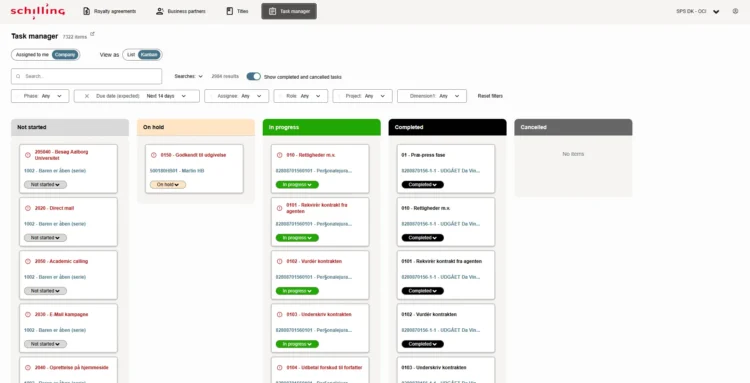
With our intuitive, intelligent search and filtering options, you can get a crystal-clear overview – either in a structured list view or in a clear, easy-to-read Kanban format.
Full visibility and control across your entire publishing operation
Bring structure, transparency and control to your publishing operation:
- Give every department an overview of all activities, and find and distribute information easily
- Be ready for change based on a full overview of all publications
- Work efficiently with user-friendly project templates for all processes
- Calculate royalties automatically with recorded author agreements
- Improve quality and employee satisfaction with accessibility, transparency and ease of use
- Increase earnings and performance with a transparent, accurate foundation for decisions
You’ll have metadata under control and ensure that the right data is accessible. You’ll be able to calculate and follow up on projects more accurately. You’ll even find releasing new formats of the same work easy, thanks to convenient templates.
All-in-one publishing lifecycle management software
Key features
All
Full overview
Gain a complete overview of all publications and budgets.
Automation & efficiency
Maximise efficiency with automated workflows.
Information sharing
Enable seamless information sharing across departments.
Transparent planning
Save time through clear and transparent planning.
Better decision-making
Increase earnings with accurate, reliable decision support.
Single point of entry
Work in one unified system with a single point of entry.
Full overview
Gain a complete overview of all publications and budgets.
Automation & efficiency
Maximise efficiency with automated workflows.
Information sharing
Enable seamless information sharing across departments.
Transparent planning
Save time through clear and transparent planning.
Better decision-making
Increase earnings with accurate, reliable decision support.
Single point of entry
Work in one unified system with a single point of entry.
Select your preferred language for your royalty management solution

Get an introduction based on your everyday processes
Start with a short conversation about your needs, processes and ambitions
Let’s have a conversation about your current processes and explore how the Schilling Publishing Lifecycle Management solution can create greater visibility and control, while supporting a more efficient day-to-day publishing operation.
Schilling Publishing Lifecycle Management
Schilling Publishing Lifecycle Management is a solution that helps publishers in the entire publishing process from idea to final publication in the whole organisation – including decision basis, planning, budget, corrections, ordering, sales, reports, evaluation, etc.
Efficient planning and automated work routines from start to finish
With the entire publication process supported in one system you only need to enter data once. Authors, agents, books, and sales figures are automatically used everywhere. If you use other Schilling modules the benefits are even greater. For example, the basis for a rights agreement is generated automatically when you create a new project. And if you send a print order, a purchase order is created automatically.
Organise your ideas and keep track of projects
With PLM you can easily support the generation of ideas for publications and content. The system uses project templates that ensure that a lot of information is filled in beforehand for particular genres and product types. It is easy to create a product idea when resources, literature group, chief editor, etc. are filled out automatically. The entire approval process is optimised with notifications for the chief editor when something needs to be approved, and with a complete overview of time schedules and financial status. If a project is approved based on the estimate, the entire process starts. The budget is prepared for the project, and then the content can be finalised. You can also register time from the production plan – this is very
Supporting the financial status and administration of the project
Everybody can always see a current and accurate overview of the financial status of the project for each line, where the actual figures are compared with the budget and show any deviations. PLM controls and runs the important financial processes in a project, and checks for example if you have the permission to register time or post costs on the project. PLM also controls automatic transfer of value to stock and depreciation of digital productions. You can extract deviation reports to see which projects deviate the most when it comes to budget and actual figures.
Flexible and time-saving budgeting
When you make budgets in a project, you can easily generate an estimate and set up alternative business cases. As metadata is specified in the project, the costs are updated automatically. This gives you a realistic picture of the production costs and how the income is distributed throughout the lifetime of the product so that you can make the right business decisions. You can save a lot of time with the in-built budget templates when for example the media type, paper, printing ink, etc. are filled in beforehand. You can copy budgets for other projects, select or deselect particular elements, reuse existing data, and in this way make the most of the template.
You can create new projects with information that is already filled in. This is a great time-saver, and if you change the specifications the costs are updated in the budget automatically. You will always have a good idea of the financial status of the project. On new editions and impressions the production plans are automatically created with fewer activities than on the original projects; likewise the costs in the budget will be lower.
Optimise sales with metadata
When you are going to publish a product, the system gathers all the information about the product that should be used for marketing. You can see a sales estimate, which ensures that you have realistic income expectations, including seeing and adjusting the expected sales month by month and year by year for different sales channels with different prices and discounts. You can keep track of how well a particular title is selling in all its different formats such as e-book, audio book, leaflet, printed book, etc.
Clear allocation of responsibilities and tasks
It is vital for the production process that both employees and external resources are involved in the right way. PLM allocates the project roles and gives the individual employees a clear overview of their tasks so that they are always up to date with their responsibilities and deadlines. This makes communication between employees from different departments easier when everything is stored in one place. Everybody can see when they are expected to do something. For example, when the editor qualifies a project it is automatically sent to the chief editor for approval, and then the rights department will receive a notification to let them know that they can start preparing the contract.
Supporting all workflows and automated processes
During the entire project period PLM ensures that all users in the organisation have the tools they need to carry out their tasks in the best possible way. You can also build the special searches and reports you need to control your publications: Overview of ideas, which projects are ready for approval, which ones still need to be approved, publication overview, expected annual income and expenses, etc.
FAQ – Publishing lifecycle management
The publishing lifecycle refers to the lifecycle of a publication. Publishing lifecycle management (PLM) is the process of monitoring and optimising each step of a publication's journey from initial concept to final publication. It supports the entire process from the very first idea, evaluation of the project, budgeting, detailed planning, to when the final product comes to life. Publishing lifecycle management covers sales and reprints until it is decided not to continue the publication. A good PLM system ensures that each stage is managed effectively, providing a clear overview and efficient workflows.
Publishing lifecycle management (PLM) is important for publishers because a title can be published in many formats and editions and may include many stakeholders and activities. An efficient PLM system helps publishers plan better, meet deadlines, and control costs. It reduces errors and ensures that everyone involved has a clear understanding of the process and status of the project. Many PLM systems also automate processes and streamline data entry, saving time and ensuring consistency throughout the organisation.
Publishing lifecycle management (PLM) software simplifies and streamlines project workflows, automates tasks, improves communication between teams, and reduces time spent on manual processes. PLM software is essential to keeping an overview of all project activities, making sure that they are carried out at the right time by reminding the responsible employee, and making adjustments if any activities are not done in time. PLM software can send notifications to stakeholders who need to approve the project or start negotiating contracts with authors or other contributors as soon as a project is approved. It also includes functions for budgeting costs and revenue.
Publishing lifecycle management (PLM) software should handle all stages of a publication, from the very first idea, planning, review, approval, and all the way to production and distribution to when the product is discontinued. Advanced PLM systems allow publishers to define stages at different levels of the hierarchy, such as title, ISBN, and impression, with flexibility for data entry or read-only access depending on the progress of the project.
Publishing lifecycle management is a vital tool for project planning, as the planning of a publication is very complex and includes many interdependent activities and many external and internal stakeholders who are each responsible for carrying out one or more activities at certain times. The project plan is usually revised many times, so you need to be able to quickly reschedule an entire project plan or change stakeholders in case someone is sick, no longer works in the organisation, or needs to dedicate their time to a different project. Advanced PLM systems also provide overviews of expected start and end dates for activities, and alert stakeholders about upcoming deadlines or delays. This ensures that projects remain on track and smoothly adapt to any changes.
Publishing lifecycle management (PLM) software usually includes features for budgeting and version control, which helps publishers manage costs, track expenses, and keep a clear record of changes in the project. A PLM system should allow you to make as many versions of a budget as you need and to compare the budget versions with each other. Some systems allow you to compare budgets with actual figures at title level, ISBN level, and impression level; this gives you detailed knowledge of when costs or revenue exceed expectations. These tools help publishers identify discrepancies, optimise financial performance, and ensure accurate record-keeping throughout the project.
Publishing lifecycle management (PLM) software tracks costs, revenues, and resource allocation, giving you a clear overview of the profitability of your publishing projects. Advanced PLM systems can help you calculate costs based on the information you enter on the project, for example number of pages, illustrations, paper type, cover type, etc. For physical publications the expected cost price per copy can be calculated automatically based on the ordered quantity. This functionality helps publishers make informed decisions about current and future projects by identifying profitable opportunities and minimising risks.
There are many benefits of using end-to-end publishing lifecycle management (PLM) software. It ensures consistency, improves collaboration among different stakeholders, and gives publishers a better project overview. It provides a seamless workflow from idea and planning to publication, reduces errors, and increases profitability. Notifications ensure that all stakeholders carry out their tasks on time. A PLM system includes a calculation planner that outlines the entire project plan. It also provides budgeting facilities and can make comparisons between different budget versions and actual figures. PLM software enhances operational efficiency and decision-making throughout the publishing process.
Many PLM software solutions integrate with other publishing tools, such as asset management and financial systems, which creates a smooth workflow and reduces the need for manual tasks. Integration capabilities help ensure that all aspects of the publishing ecosystem work together efficiently, from project planning to financial reporting.
A publishing lifecycle management system should include a replacement feature that you can use in case of sickness, vacation, resignation, etc. so that if a team member leaves others can pick up where they left off without losing track of project progress or important data. Tasks can be reassigned to a new stakeholder, left open for reassignment later, or selectively reassigned as needed, maintaining clarity and continuity within the project.